

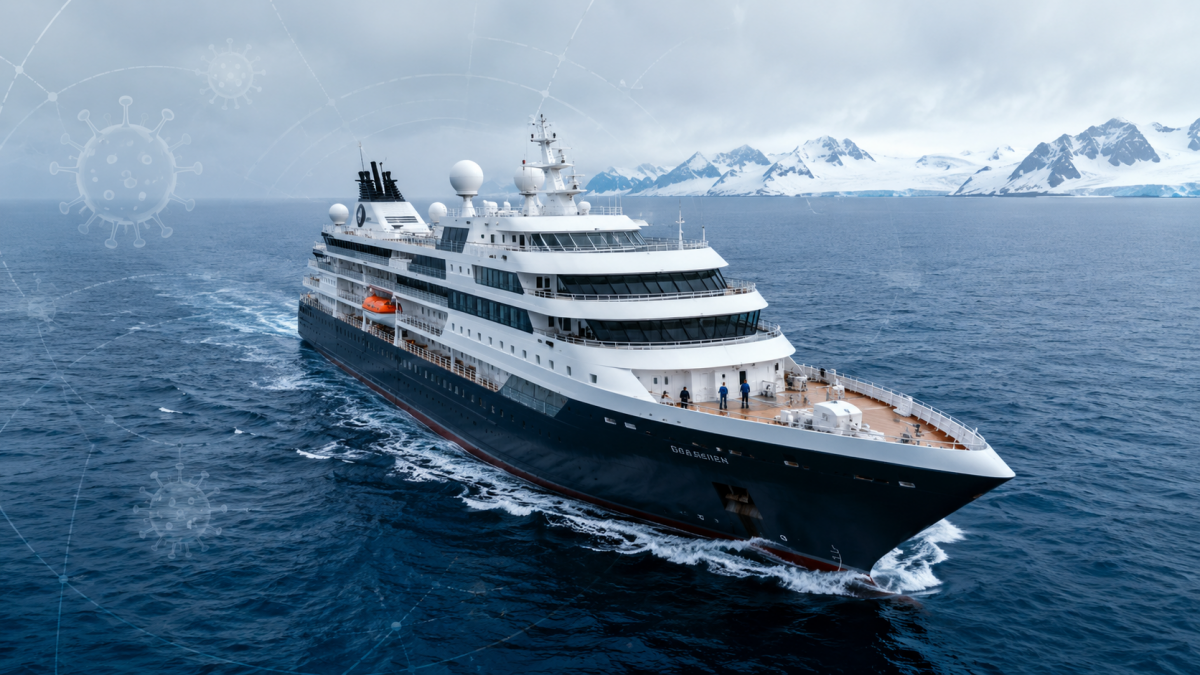
SHARED HYGIENE – THE HONDIUS CASE
2026-06-04 BacteriaBusinessEco Silver PaperHygieneProtection
In May 2026, the name Hantavirus returned to the center of international attention due to an outbreak linked to the MV Hondius, an expedition ship operated by Oceanwide Expeditions on an itinerary in the South Atlantic.
According to updates from the WHO, the ECDC and the Italian Ministry of Health, the cluster was associated with the Andes virus, a Hantavirus strain that is rare in the European context. The ECDC reported the event on 2 May 2026, referring to the involvement of passengers and crew from many countries. In its update of 22 May 2026, the WHO indicated more than 600 identified contacts in 32 countries, territories and areas, placed under monitoring or self-monitoring according to their risk level. The Italian Ministry of Health also published specific circulars with updates and operational guidance for managing suspected, probable and confirmed cases.
The risk for the general population in Europe was assessed as low. However, the Hondius case has brought renewed attention to an issue well known to those working in professional cleaning, HoReCa and hospitality: preventing infectious risk in shared environments.
What is Hantavirus?
Hantaviruses are zoonotic viruses, meaning viruses that originate in animals and can be transmitted to humans. Their natural reservoir is mainly certain rodent species. Ordinary transmission occurs primarily through the inhalation of particles contaminated by urine, feces or saliva from infected rodents. This can happen when dust is stirred up in closed environments, storage areas, warehouses, technical rooms, cellars or rarely used spaces where contamination may be present.
More rarely, infection can occur through direct contact with contaminated materials or through small injuries to the skin and mucous membranes. For most Hantaviruses, person-to-person transmission is not the typical route of spread.
The Andes virus, however, is an important exception: in addition to environmental transmission linked to rodents, it can also spread between humans in close-contact conditions, especially when symptomatic people are present. This feature makes it particularly relevant in closed, community-based settings where many people spend time together.
Confined spaces, many people, shared surfaces
The MV Hondius case is exceptional because of the viral strain involved and the context in which it developed. However, the scenario it highlights is very concrete: closed spaces, long periods spent together, a high density of people, shared surfaces and the need for well-structured hygiene protocols.
Ships, hotels, accommodation facilities, hospitals, airports, common areas and high-traffic locations all have one thing in common: every day, many people come into contact with surfaces, services and materials used by different users. For this reason, episodes like this should not create alarm, but awareness. Prevention does not come from a single product or a single action, but from a coordinated set of good practices: proper cleaning, disinfection when necessary, ventilation, pest control, staff training and the informed choice of consumable materials.
What protocols are needed in hospitality facilities?
In hotels, ships and high-traffic environments, preventing infectious risk requires clear procedures, applied consistently and verifiably over time. The most important measures include regular cleaning of frequently touched surfaces, such as door handles, handrails, control panels, reception counters, tables, remote controls, faucets, bathroom fixtures and dispensers.
Disinfection must be targeted and carried out when necessary, using suitable products and respecting dilution, contact times and methods of use. Pest control is also essential, especially in warehouses, kitchens, technical rooms, storage areas, laundries and waste areas.
These aspects are complemented by ventilation of indoor spaces, proper waste management, appropriate use of PPE and staff training. A protocol is effective only if the people who apply it understand the difference between cleaning, sanitizing and disinfecting.
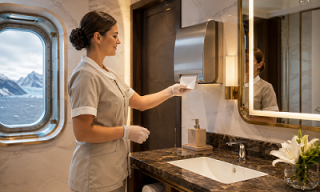
Prevention also depends on materials
In professional cleaning, there is often talk of detergents, disinfectants and operating procedures. But daily prevention also depends on apparently simpler elements: hand towels, rolls, disposable materials and products intended for frequent contact with people. In high-traffic environments, every detail contributes to building a culture of hygiene. The quality of the materials used in bathrooms, rooms, common areas, professional kitchens and service areas becomes an integral part of the safety experience perceived by guests, operators and users.
This is where Eco Silver Paper® fits in: a line of paper developed with a virucidal treatment based on ionic silver, designed to contribute to a more advanced approach to hygiene in professional environments.
Eco Silver Paper® does not replace proper cleaning, disinfection, ventilation and pest-control practices. However, it can be integrated into a broader strategy of documented professional hygiene, offering cleaning and HoReCa distributors a distinctive proposal focused on quality, prevention and responsibility.
The Hondius case reminds us that prevention is not an extraordinary measure to activate only during an emergency. It is daily work, made of procedures, control, training and appropriate materials.
Because prevention is not built during an emergency. It is built every day, even through the simplest choices.

LATEST COMMENTS